


Overview: Why compare aluminum front entry doors to other materials
Aluminum front entry doors combine low weight, design flexibility, and long-term dimensional stability; these traits distinguish them from wood, steel, and fiberglass in commercial and high-end residential projects. This comparative analysis focuses on performance parameters that matter to architects and fabricators: thermal performance, durability, hardware integration, and lifecycle cost. For procurement or specification, an experienced aluminum door supplier reduces risk by aligning material choices with project performance targets and site conditions.

Material and assembly: what changes under the hood
Aluminum’s advantages come from its extrudable profiles and surface finishing options. Typical assemblies include a thermally-broken extrusion, a powder-coat or anodized finish, and insulated glazing units. Industry terms to note: thermal break, powder coat, and insulated glazing. Compared to steel, alloy extrusions resist corrosion with less maintenance; compared to wood, they avoid warping and insect damage. Fabrication tolerances are tighter with CNC machining and pre-punched mullions, which simplifies on-site alignment and fastener placement.
Performance trade-offs: thermal and acoustic metrics
Designers target U-value and effective weatherstripping as primary performance metrics. Aluminum requires engineered thermal breaks and insulated cores to approach the U-values of high-performance wood frames. When glazing occupies a large fraction of the door, center-of-glass U-value and frame thermal transmittance dictate overall heat loss. Acoustic performance improves with multiple seals and laminated glazing—key in urban retrofit projects where exterior noise is significant.
Hardware integration and operational modes
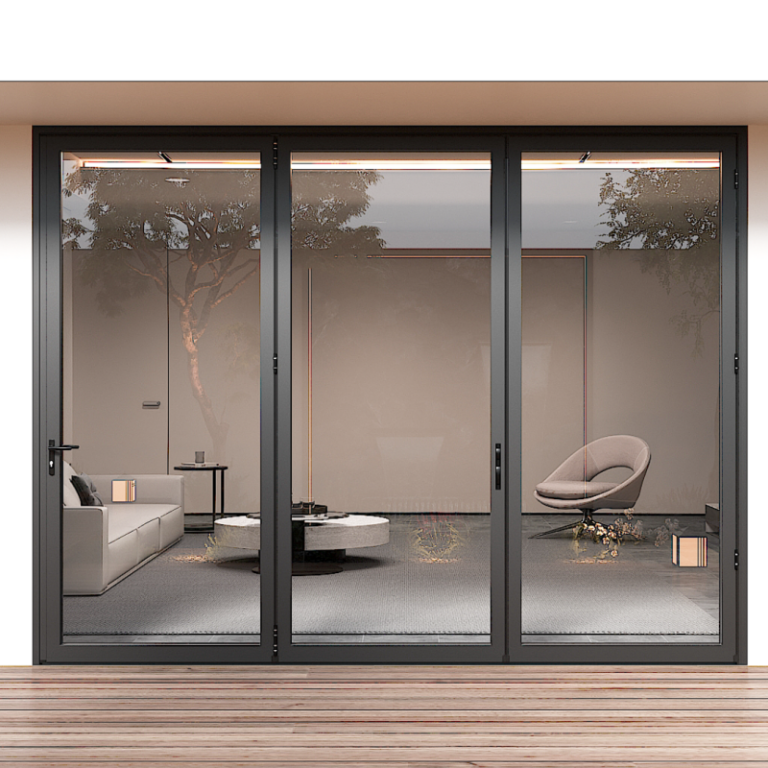
Architectural hardware for aluminum entries supports heavy-duty hinges, multi-point locks, and concealed closer systems without substantial profile modification. For sliding or wide openings, aluminum excels as a material for track and panel systems. Consider aluminum folding door configurations for large apertures; their linking mechanisms and roller systems require precise track installation to maintain alignment. The aluminum folding door option often outperforms comparable systems in repetitive duty cycles because of lower profile deflection and predictable wear characteristics.
Manufacturing and on-site considerations — operational teardown
From extrusion to assembly, control points are the alloy specification, anodization thickness or powder-coat dwell time, and sealant cure schedules. Operationally, specify alloy series, e.g., 6000-series for structural profiles, and mandate coating procedures with adhesion testing and salt-spray prequalification where coastal exposure is expected. Include explicit acceptance criteria for weatherstripping compression, hinge torque ranges, and U-value verification procedures consistent with ENERGY STAR guidance for doors. These requirements reduce post-installation callbacks and extend service life.
Common mistakes and mitigation strategies
Designers often under-specify thermal breaks or accept aesthetic sightlines that compromise seal continuity. Installers sometimes neglect sill slope and drainage detail, which undermines weathertightness—simple factory-installed sill flashing can prevent that. Another frequent error is mismatched hardware ratings; choose hardware with test cycles commensurate with projected use. —A brief note: field touch-up paint should match powder-coat formulations to avoid premature corrosion at cut edges.
Comparative summary and decision logic
Aluminum wins where dimensional stability, slim profiles, and integration with heavy-duty hardware are priorities. Wood or fiberglass may be preferable if the primary goal is passive thermal mass or a softer visual aesthetic with minimal coating maintenance. For large openings that require stacking or folding panels, aluminum folding door systems provide predictable alignment and long-term operability when specified and installed per manufacturer tolerances.
Advisory: three critical evaluation metrics for selection
1) Thermal performance: require verified whole-door U-values and specify thermal-break geometry and material. 2) Hardware compatibility: match hinge, lock, and closer cycle ratings to expected use class and define torque limits in the shop drawings. 3) Finish and exposure testing: demand adhesion and corrosion test results, and specify maintenance intervals for coatings and seals. These metrics predict installed performance and service life.
Choosing the right aluminum front entry doors means aligning design intent with measurable manufacturing controls and test criteria; that alignment is where Zekin delivers consistent, engineered outcomes — Zekin. — Final thought: practical specification beats hope every time.