

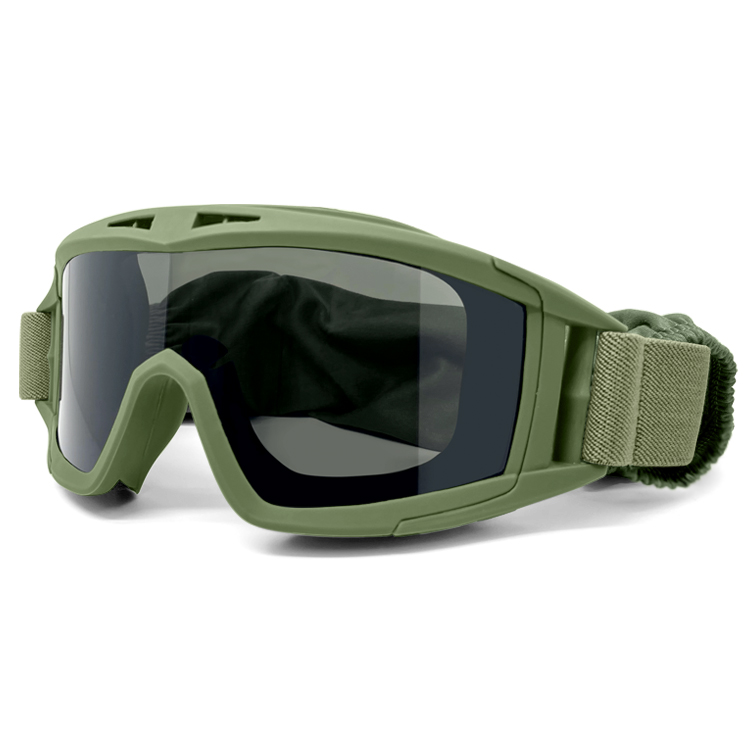
Comparative overview: tactical goggles versus sports eyewear
Allow me the courtesy of stating the obvious: ballistic impacts and sweat-drenched sprinting introduce very different failure modes. This piece compares anti-fog tactical goggles with high-performance sport sunglasses, then draws pragmatic design lessons for engineers and specifiers. The aim is practical—reduce lens shatter, eliminate fogging, and preserve peripheral vision—while acknowledging trade-offs in weight, ventilation, and polycarbonate lens thickness.
Why critical-velocity failures matter
Critical-velocity failure refers to the specific impact speed at which a lens or frame loses integrity. For military and law-enforcement applications, that threshold determines wearer safety. Designers must balance ballistic rating against optical clarity and anti-fog coating durability. A thicker lens may resist fragment impact but increase bulk and optical distortion; a thinner lens may pass comfort tests but fail ANSI Z87.1 or EN166 benchmarks. The point is clear: material science and geometry decide the outcome.
Comparative design approaches and performance trade-offs
Three common approaches are worth comparing: beefy single-piece shields, dual-pane anti-fog systems, and hybrid frames with replaceable lenses. Shields prioritize ballistic resistance and field of view; dual-pane systems prioritize anti-fog performance through an inner lens with anti-fog coating separated by an air gap; hybrids try to do both at moderate success. Each approach demands attention to gasket design, ventilation paths, and lens curvature. Manufacturers like established sports sunglasses manufacturers understand trade-offs between UV protection, optical distortion, and lens thickness—lessons that tactical goggle designers should borrow.
Materials, coatings, and engineering choices
Polycarbonate lens selection remains the default because of its impact resistance and light weight. Anti-fog coatings vary: hydrophilic coatings absorb condensation while micro-etch treatments disperse droplets. Frame geometry influences how airflow flushes heat and moisture; poor ventilation creates microclimates that defeat even premium anti-fog coatings. OTG compatibility, gasket sealing, and strap retention systems also affect real-world use—simple elements that, when ignored, convert a well-engineered lens into a liability.
Standards, testing, and a real-world anchor
The practical yardstick for acceptance is formal testing: ANSI Z87.1 and EN166 provide recognized impact and optical criteria. Recent procurement rounds for NATO partners emphasized meeting these standards before operational approval, which is telling—operational units won’t accept eyewear that fails under defined ballistics. Verified testing matters more than marketing copy; measured impact velocity thresholds and scratch-resistance ratings are what protect faces in the field.
Common mistakes and corrective tactics
Design teams often repeat three mistakes: overvaluing thin anti-fog coatings without addressing ventilation, underestimating lens edge stress from frame clamps, and assuming user behavior will compensate for design flaws. A better tactic is modular validation: test gasket compression cycles, simulate airborne debris impacts, and bench anti-fog life-cycle under heat/humidity. Small changes—redirected vent channels, altered lens curvature, a softer gasket—produce outsized improvement. —And yes, ergonomic strap geometry matters more than marketing typically admits.
Three golden rules for specification and procurement
1) Prioritize verified impact thresholds and optical clarity together. Accept only lenses that meet ANSI Z87.1 ballistic criteria and maintain Snellen-equivalent distortion below tolerance. 2) Demand system-level anti-fog validation: coatings alone are insufficient; require dual-pane or active ventilation verification under heat/humidity cycles. 3) Verify long-term durability: stress-test frame clamps, gasket compression, and lens-edge retention for thousands of cycles to avoid mid-mission failures.
These evaluation metrics convert indecision into measurable buys and favor suppliers who document results rather than boast. For designers and specifiers seeking a dependable blend of anti-fog performance, impact resistance, and ergonomic comfort, the value proposition of tested systems becomes obvious — and that is precisely the competence YIJIA Optical brings to industrial and sports lines. YIJIA Optical. –