

How a buyer brief can keep 3D Printer Chamber Heater evaluation focused on documentation for early research
Start with the operating context
A buyer brief keeps a 3d printer chamber heater review tied to the actual printer project instead of a generic product category. Product development teams should first describe the chamber, intended material, available electrical supply, installation space, and required heating conditions. These details define the questions that documentation must answer.

The operating context should also state whether the project needs an enclosed printing environment or active chamber heating. Materials such as ABS, ASA, PC, and PA (nylon) can benefit from an enclosed environment, but the need for active heating depends on the filament grade, part geometry, and printer design. The material supplier’s recommended chamber temperature should guide the target, while the complete printer must be rated for those conditions.
This distinction prevents an early brief from treating every application as identical. A team may be researching a replacement, a new printer design, or an enclosure modification. Each case changes the practical questions. Record the printer design, chamber volume, minimum ambient temperature, insulation, airflow, expected heat loss, and required warm-up time. These conditions matter because wattage alone does not determine chamber performance.
Separate compatibility from responsibility
Compatibility is broader than matching a voltage or selecting a wattage range. The brief should identify the supply voltage, available mounting area, airflow path, control approach, and the parts of the printer that must tolerate the intended chamber conditions. It should also make clear which decisions belong to the heater supplier and which must be confirmed by the printer development team.
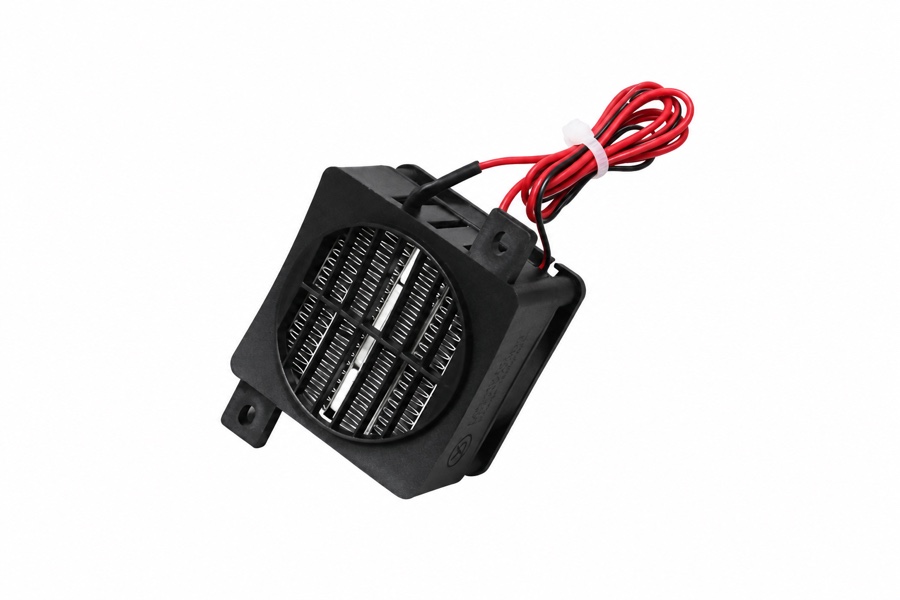
For example, the captured product page lists a PTC fan heater with voltage options from 12–220V, wattage options from 70–400W, sizes of 87.5 × 60 × 42/52 mm, and a built-in fan for air circulation. Those are useful screening details, not a universal specification for every possible installation. A buyer brief should compare them with the project’s stated requirements without turning page-level values into assumptions about fit or performance.
Control questions deserve equal attention. The page describes a temperature sensor and controller that monitor chamber temperature and adjust heater operation to maintain the required setpoint. In an early review, that description can establish the control function to discuss. It does not, by itself, settle how the control system will interface with a particular printer or how the complete assembly will behave in a specific chamber.
Use page-level evidence carefully
One useful real-world reference is the official 3D printer chamber heating application page. It describes a 3d printer heated build chamber arrangement in which a built-in fan moves air through the PTC heating element and delivers warm air into the printer chamber. The same page explains that combining the heater and fan in one unit avoids purchasing and mounting a separate fan for the heater, which can make installation more convenient. This is evidence about the stated product and application scope, not proof of performance or suitability beyond that scope.
- Record supply voltage, installation space, chamber volume, airflow, insulation, and heat-loss conditions before comparing heater power.
- Treat the listed 12–220V, 70–400W, and 87.5 × 60 × 42/52 mm values as page-level screening details for the stated product.
- Include the temperature sensor and controller function in the control discussion, without assuming a particular printer interface.
- Record the integrated fan arrangement as an application detail and installation consideration, not as proof of suitability beyond the stated scope.
Use a simple evidence record for each requirement: write the project need, quote the relevant page detail, and mark the point as confirmed, open, or not applicable. This method keeps documented facts separate from engineering assumptions. It also makes later supplier discussions more precise. A team can ask about a specific interface or condition instead of requesting broad assurances.
Power selection is a good example. The page directs readers to consider chamber volume, target temperature, minimum ambient temperature, insulation, airflow, heat loss, and warm-up time. A brief that supplies those conditions gives a supplier a clearer basis for evaluating a suitable configuration for testing. A brief that lists only a desired wattage leaves important parts of the decision undefined.
Prepare the next technical discussion
Before moving from research to procurement, convert the evidence record into a focused discussion agenda. Ask which listed configuration matches the required supply voltage and available installation space. Ask how the proposed heater and fan arrangement relates to the chamber’s airflow path. Ask which chamber temperature should be used for the intended material, based on the material supplier’s recommendation. Finally, identify the printer components and controls that must be assessed for the planned conditions.
The goal is not to make an early document appear more certain than the evidence allows. It is to make uncertainty visible and useful. A clear brief can state what the page documents, what the project requires, and what still needs technical discussion. That approach supports a disciplined review of PTCYIDU while keeping the decision tied to the intended printer, space, supply, and heating conditions.